For trademark attorneys
You’ve been assigned an examiner. Here’s what to expect.
Refusal rates, outcomes, and timing for every active trademark examining attorney.
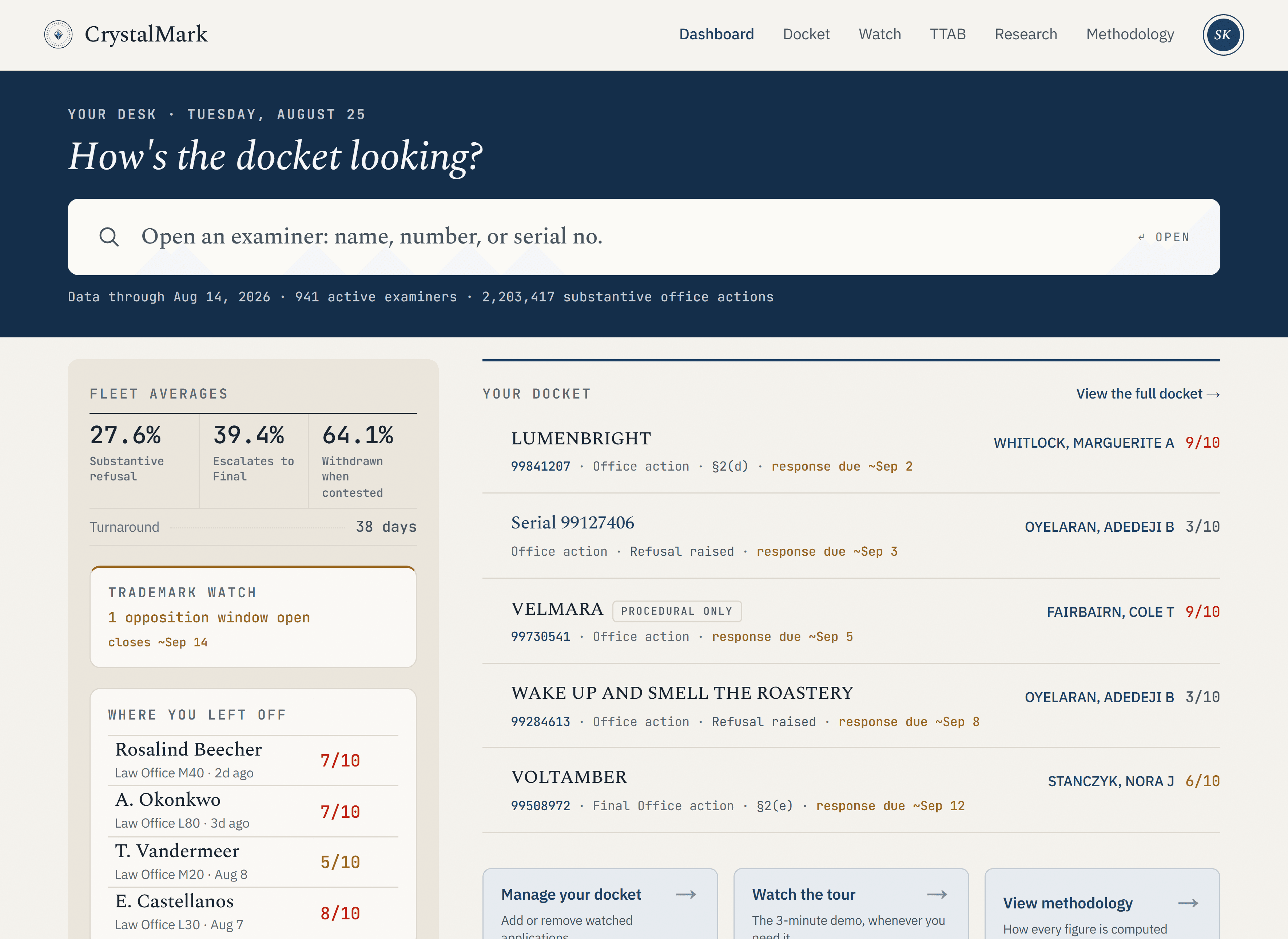
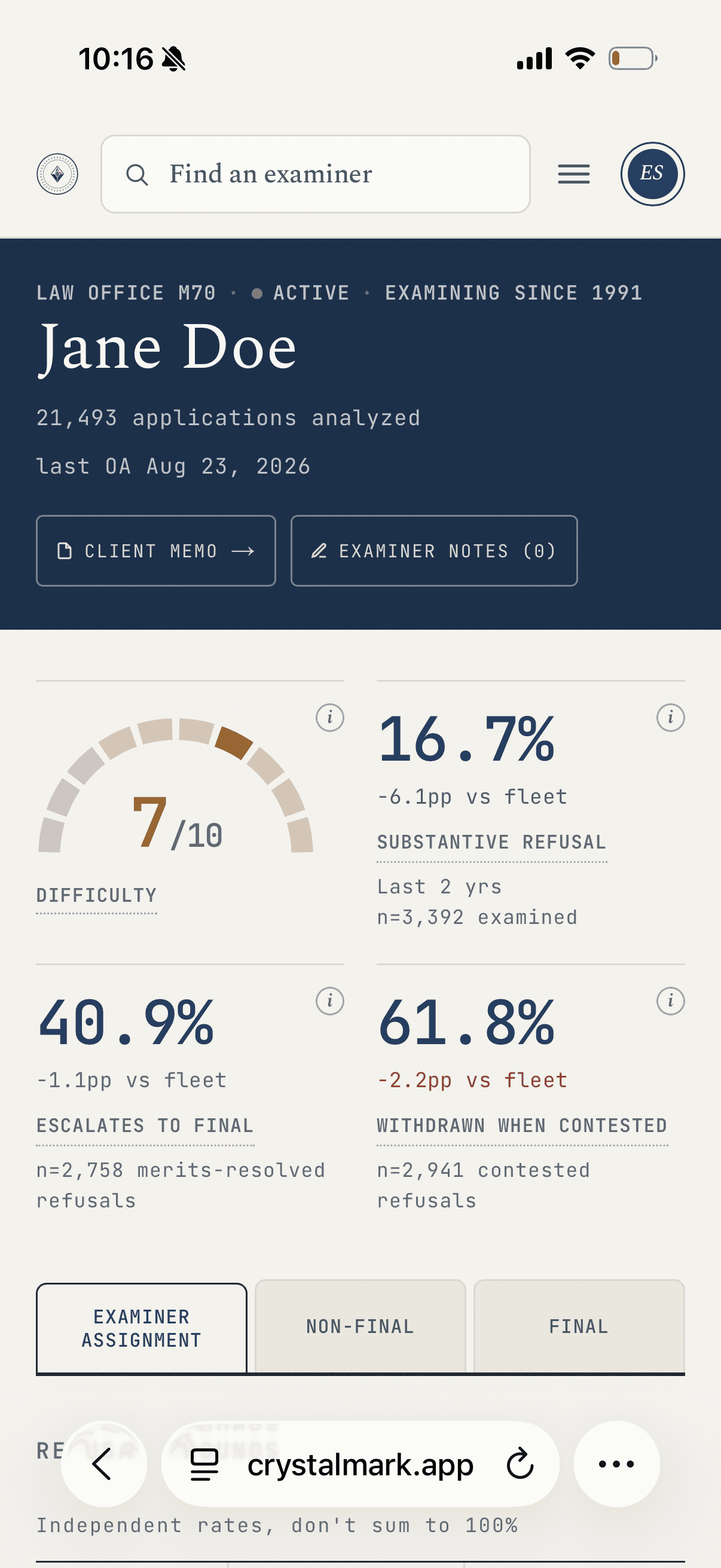
Tour a live examiner profile
A senior examiner
Last 2 yrs · n = 3,126 examined · corps 24% · −6pp
Refusal grounds · independent rates, don't sum to 100%
Will I draw a refusal?
Start with the odds: the recent refusal rate on examined applications, split by ground, each rate benchmarked against the active examining corps.
How hard is the path?
One score against the active corps: how hard a refusal from this examiner is to overcome. Weighted toward what happens after the refusal; refusal frequency counts least.
Where does a §2(d) end up?
The §2(d) record in three stages: whether the initial refusal escalates, whether an answered Final is ultimately withdrawn, and how appeals resolve.
Softening, or hardening?
Refusal rate by year, with the corps as the reference line. The profile reads the direction for you.
A senior examiner
Will I draw a refusal?
Start with the odds: the recent refusal rate on examined applications, split by ground, each rate benchmarked against the active examining corps.
Last 2 yrs · n = 3,126 examined · corps 24% · −6pp
Refusal grounds · independent rates, don't sum to 100%
How hard is the path?
One score against the active corps: how hard a refusal from this examiner is to overcome. Weighted toward what happens after the refusal; refusal frequency counts least.
Medium
More difficult than 60% of active examiners.
Where does a §2(d) end up?
The §2(d) record in three stages: whether the initial refusal escalates, whether an answered Final is ultimately withdrawn, and how appeals resolve.
Initial · Final · Appeal
of merits-resolved §2(d) refusals escalated to a Final.
corps 39% · n = 1,953 merits-resolved §2(d)s
of answered §2(d) Finals were ultimately withdrawn.
corps 70% · n = 389 answered and resolved
of resolved appeals ended with the refusal coming off.
corps 64% · n = 341 resolved appeals
The Final figure displays only at n ≥ 25 answered and resolved; below the gate the profile says so instead of guessing.
Softening, or hardening?
Refusal rate by year, with the corps as the reference line. The profile reads the direction for you.
Refusal rate by year
Easing, gently: down about 5 points from 2021 to 2025.
Substantive refusals · per-year n · dashed line = corps career average
The docket
Staged by what happens next.
Connect with the email on your USPTO filings and every pending application lands on one board. Response windows and Statement of Use deadlines run on their statutory clocks, with the examiner's record one click from every row. When something moves, you get an email.
Your docket · stage board
Response window open
· 3An office action is outstanding and the statutory response clock is running.
Illustrative rows. The live board runs eight stages over your real applications, with the examiner named and linked on every row.
The watch
A trademark watch, built in.
A §2(d) citation is only as strong as the registration behind it, and the register keeps moving. CrystalMark watches it from both ends of your practice.
The marks you own
A mark moves from your docket to the watch the day it registers. When an examiner cites it in a §2(d) refusal of someone else's application, the citing case links its full story. If that application is later published for opposition, the alert lands while the opposition period is open.
BRIARFIELD · cited your registration · published for opposition
The marks cited against you
The registrations cited against your applications are watched too. These are the events USPTO never emails: a cited registration cancelled or expired while your refusal sits, counted dead on the docket row it blocks.
TALLOW & THREAD · cited on your Final · registration cancelled
The gap
A case list isn't a strategy.
Other tools give you an examiner's registration rate and a list of cases. CrystalMark tells you whether your client can still reach publication, and what the record says about each barrier in the way.
The margin
Stop quoting responses blind.
A substantive office-action response is a flat quote, and the examiner decides whether it stays one round or becomes three. On a flat fee, that variance comes out of your margin, not the client's.
Big shops read the refusal before they quote. CrystalMark lets you read the examiner too: how often their refusals stick once contested, how many rounds a refused application runs. Price the response like you've seen this examiner's refusals play out before. Statistically, you have.
What you get
One subscription.
Every active examiner.
The tour above is one profile. A subscription runs the same instruments on every active examiner, refreshed daily, with the sample behind every rate and the examining corps beside it.
Timing & rounds
Median wait from filing to a first office action, and the average response rounds a refused application runs. Queue time and examiner behavior, kept separate.
Specialist examiners
When an examiner's docket concentrates in one product world, the chip sits beside the name: Specialist · Tequila. You know whether yours reads marks like your client's all day.
Built for firms
A seat per attorney, one subscription. Examiner notes and watches are shared across the firm and private to it.
The methodology, public
Every stat's formula, denominator, and publish gate, on one page anyone can read.
The appeal read
What happens if you appeal.
Everyone quotes the same folklore number: nine appeals in ten, affirmed. It counts only the appeals that reached a decision. Counted from the notice of appeal, the record reads differently.
the folklore: §2(d) refusals affirmed on appeal.
True, but only of appeals the Board decided.
of resolved appeals ever reach a Board merits decision.
The other 85% resolve before the Board rules on anything.
of resolved appeals end with the refusal coming off.
Usually the examiner withdrawing the refusal, at a median 2 months vs ~10 to a decision.
The full appeal record, year by year →
Refusal counts start at 2007 with the office-action corpus; the TTAB cells cover the Board's full record. Kept separate from the recent-window rates you respond against.
The coverage
We already have your examiner.
Every active USPTO trademark examiner has a public page in our examiner directory. The behavioral read is what you unlock.
Free to search · no account needed
See the live example, fully unlocked →Honest proof
Every figure traces to the public USPTO record.
Verify it yourself.
We're new (est. 2026), so we don't ask you to trust a quote. Each number is computed from the public file history and shown with its sample size, and the headline rates are benchmarked against the active examining corps.
Built on public record
Every figure is computed from the public USPTO file-wrapper history: attorney↔examiner office actions and TTAB cases. Nothing private.
Every number is checkable
The §2(d) barrier rows open to the underlying applications, every serial with its response route and outcome, and every rate names its sample.
Thin samples stay unpublished
Every published rate names its sample. Below the gate we withhold the rate rather than fake precision: the profile shows the raw count and the corps figure beside it, clearly labelled as the corps and never as this examiner.
Active-corps benchmarks
"More difficult than 70% of active examiners" is measured against the examiners taking cases today. An all-time average would flatter the number.
Your client's mark can still
reach publication.
See the record that got there with this examiner.